For years, marketers have debated the same question: should brands invest in paid ads or focus on organic growth? On the surface, both approaches promise visibility, traffic, and conversions. But when budgets are tight and results matter, the real conversation shifts toward return on investment.
Understanding organic marketing vs paid ads isn’t about choosing sides. It’s about understanding how each channel delivers value, how quickly it performs, and how sustainable its impact really is.
The Immediate Appeal of Paid Advertising
Paid advertising is often the fastest way to generate results. Launch a campaign, set a budget, and your brand appears instantly in front of a targeted audience. This speed is why many businesses rely on paid ads for launches, promotions, and short-term growth.
When it comes to paid ads ROI, the biggest advantage is control. Marketers can test creatives, audiences, and offers in real time, adjusting campaigns based on performance data almost instantly. If something works, it can be scaled. If it doesn’t, it can be paused.
However, this immediacy comes with a trade-off. The moment spending stops, visibility disappears. Paid ads deliver results as long as the budget is active, making ROI highly dependent on continuous investment and constant optimization.
The Long-Term Power of Organic Marketing
Organic marketing takes a very different approach. Instead of buying attention, it earns it over time through content, search visibility, social engagement, and brand authority. This is where SEO, thought leadership, and consistent content creation play a major role.
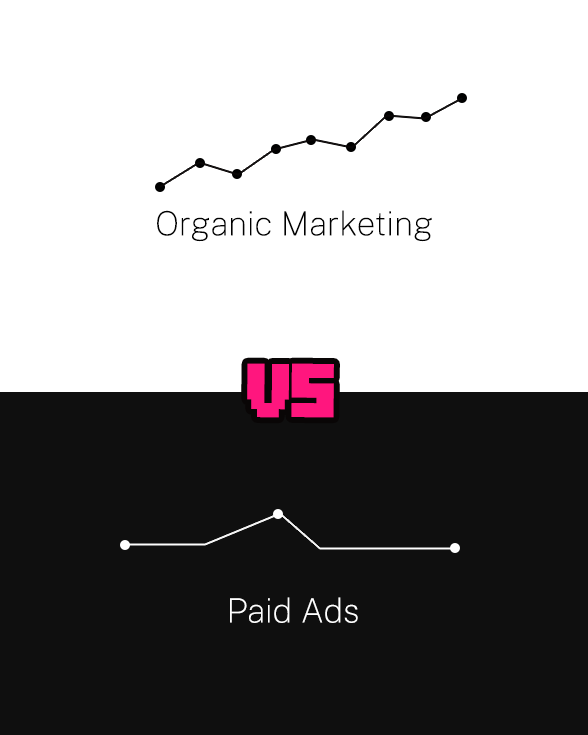
Unlike paid campaigns, organic efforts compound. A well-ranked article or high-performing piece of content can continue driving traffic and leads months or even years after it’s published. While results take longer to appear, the long-term efficiency often outweighs the initial wait.
This is why discussions around paid ads vs SEO ROI are rarely straightforward. Paid channels deliver speed, while SEO delivers durability.
SEO vs PPC Performance: Speed vs Sustainability
Comparing SEO vs PPC performance highlights one of the biggest differences between these strategies. PPC excels at capturing high-intent users immediately, especially for competitive keywords and time-sensitive offers. SEO, on the other hand, builds credibility and trust over time, attracting users who are actively searching for solutions without direct cost per click.
PPC performance is easier to measure in the short term, with clear metrics tied to spend and conversion. SEO performance requires patience but often results in lower acquisition costs once momentum is established.
In practice, PPC wins on speed. SEO wins on longevity.
Which Channel Delivers Better ROI?
The answer depends on how ROI is defined.
If ROI is measured by immediate revenue and fast feedback, paid ads often appear stronger. If ROI is evaluated over months or years, organic marketing frequently proves more cost-effective. This is why the debate around organic marketing vs paid ads shouldn’t end with choosing one over the other.
The most effective strategies use both. Paid ads generate short-term traction, test messaging, and drive immediate conversions. Organic marketing builds brand equity, reduces long-term costs, and creates a foundation that paid efforts can amplify.
The Smart Approach: Integration, Not Opposition
High-performing brands don’t treat this as an either-or decision. They use paid ads to support organic efforts and organic insights to improve paid campaigns. Data from PPC can inform SEO priorities. Organic content can be repurposed into high-performing ads.
When both channels work together, paid ads ROI improves, organic visibility strengthens, and overall marketing efficiency increases.
The Bottom Line
Paid ads and organic marketing serve different purposes, timelines, and goals. One delivers speed and precision. The other builds trust and sustainability. When viewed through the lens of paid ads vs SEO ROI, the real value comes from alignment, not competition.
The brands that win aren’t asking which channel is better. They’re asking how to use both intelligently, maximizing short-term gains while building long-term growth.
Because the best ROI doesn’t come from choosing sides. It comes from choosing balance.
At A2Z Media Group, we design integrated paid and organic marketing systems that help brands grow with clarity, efficiency, and long-term impact, not quick wins that fade.
Written by:
Performance & Growth Team at A2Z Media Group